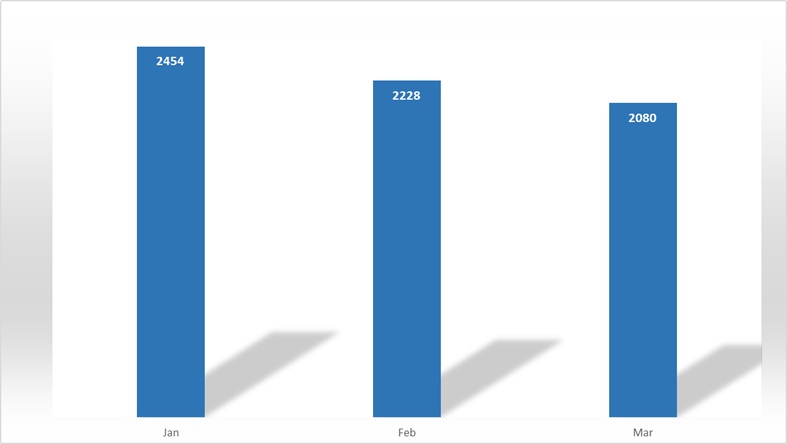
(TITC) – Amid ongoing disruptions to global tourism caused by geopolitical conflicts, transportation bottlenecks, and rising travel costs, Viet Nam’s tourism sector has continued to post impressive growth. In March 2026 alone, the country welcomed nearly 2.1 million international arrivals, bringing the total for the first quarter to 6.76 million – up 12.4% year-on-year. This marks the highest first-quarter figure on record and the first time Viet Nam has received over two million international visitors for three consecutive months.
Figure 1. International visitors by month in 2026 (thousands of arrivals)
Source: Compiled from National Statistics Office’s data
Air connectivity plays a key role in reinforcing destination confidence
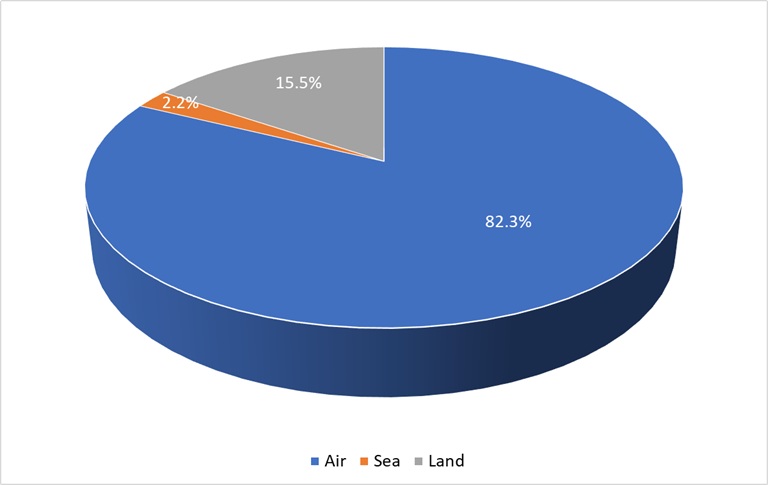
Of the 6.76 million international visitors to Viet Nam in Q1 2026, arrivals by air accounted for 82.3%, followed by land (15.5%) and by sea (2.2%).
The dominant share of air travel highlights Viet Nam’s strong appeal to medium- and long-haul markets – segments directly affected by geopolitical tensions and fuel price fluctuations. Despite disruptions to international flight routes due to conflicts in the Middle East, the sustained high volume of air arrivals reflects not only robust connectivity but, more importantly, growing international confidence in Viet Nam as a safe, stable, and accessible destination.
Meanwhile, land arrivals – accounting for 15.5% – underscore the continued importance of neighboring markets such as China, Laos, Cambodia, and Thailand. These markets benefit from geographical proximity, cost efficiency, strong recovery potential, and high flexibility.
Sea arrivals, at just 2.2%, indicate significant untapped potential in cruise tourism. With its extensive coastline, rich tourism resources, and strategic location in Southeast Asia, Viet Nam is well-positioned to develop this high-value segment, which typically involves large groups and higher spending levels.
Figure 2: Structure of international visitors to Viet Nam by mode of arrival
Source: Compiled from National Statistics Office’s data
Strong growth witnessed across international markets
In Q1 2026, China (1.4 million arrivals) and South Korea (1.3 million) remained Viet Nam’s two largest inbound markets, accounting for approximately 40% of total international arrivals.
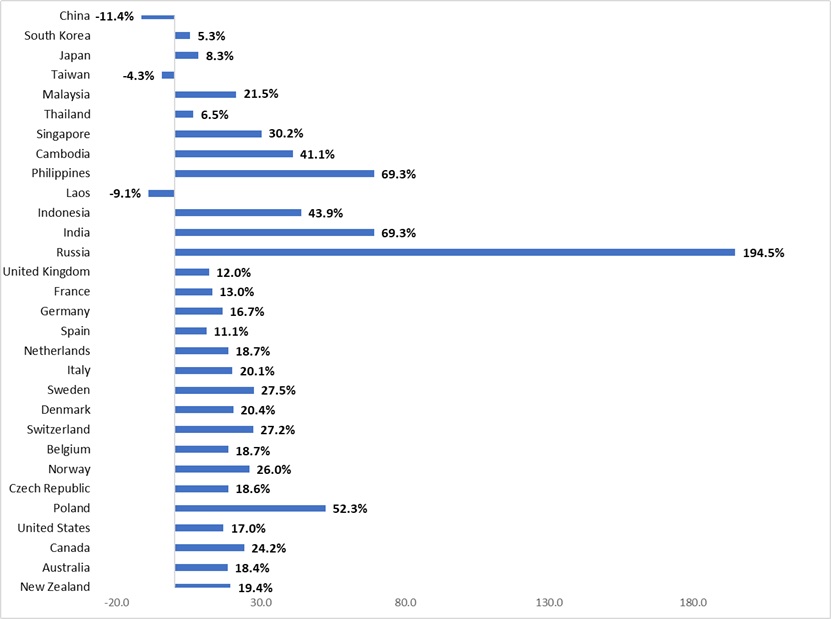
Southeast Asian markets recorded robust growth: Malaysia (+21.5%), Singapore (+30.2%), Cambodia (+41.1%), Indonesia (+43.9%), and the Philippines (+69.3%). In South Asia, India continued its strong momentum with a 69.3% increase, highlighting the vast potential of the world’s most populous market.
Europe emerged as a standout, with overall growth of 55.6%. Notably, despite flight disruptions in March 2026 due to Middle East conflicts, long-haul European markets still posted year-on-year increases: the UK (+3.0%), France (+2.3%), Germany (+15.2%), the Netherlands (+8.5%), Sweden (+9.2%), Denmark (+13.9%), Switzerland (+18.9%), Poland (+19.2%), and Norway (+12.0%). Russia, in particular, surged by 163.4%, reflecting growing interest among Russian travelers in Viet Nam as a destination.
Positive growth was also recorded in North America, with the United States (+17.0%) and Canada (+24.2%), as well as in Oceania, with Australia (+18.4%) and New Zealand (+19.4%).
Figure 3. Market growth rates for Q1/2026 compared to Q1/2025
Source: Compiled from National Statistics Office’s data
Viet Nam – a safe haven in an uncertain world
As both traditional and non-traditional security risks increasingly influence travel decisions, safety has become a decisive factor for international tourists.
In this context, Viet Nam stands out with a strong competitive advantage. Its stable political environment, well-maintained social order, and effective risk management provide travelers with a high level of safety and peace of mind. This forms the foundation of destination trust – an asset of growing importance in today’s volatile global landscape.
Viet Nam’s appeal is further strengthened by its diverse natural resources and rich cultural heritage. Trends such as experiential travel, green tourism, and local immersion are enhancing the attractiveness of many destinations across the country. The recent feature of Son Doong Cave on American CBS’s globally renowned program “60 Minutes” further demonstrates Viet Nam’s growing international visibility and appeal.

Favorable policies and effective promotion drive growth momentum
Improvements in visa policies and air connectivity continue to play a vital role. Expanded visa exemptions, longer stays, additional e-visa entry points, and increased international flight frequencies have significantly improved accessibility.
In a context of rising global travel costs, destinations that are “easy to access and cost-efficient” hold a clear advantage – and Viet Nam is capitalizing on this trend.
At the same time, tourism promotion efforts led by the Viet Nam National Authority of Tourism, in collaboration with industry stakeholders, are becoming more professional, targeted, and effective. Leveraging public-private partnerships and digital platforms, Viet Nam is strengthening its image as a friendly, stable and trustworthy destination.
Tourism Information Technology Center